Reimagining India’s mission-critical industries through connected intelligence
India is building, and it’s building fast.

New airports are rising, metro rail lines are spreading across major cities and a national gas pipeline grid is being stitched across the subcontinent. Refineries from Gujarat to Assam are expanding alongside it, racing to keep pace with the country’s fuel demand.
The trend is the result of political ambition coupled with a large inflow of capital: India’s Union Budget for 2026-27 raises infrastructure capital expenditure to ₹12.2 lakh crore, or about US$133 billion. This forms part of a much larger investment cycle: CRISIL estimates that India will spend nearly ₹143 lakh crore, about US$1.7 trillion, on infrastructure between fiscal years 2024 and 2030, more than double the roughly ₹67 lakh crore spent during the previous seven-year period.
The country’s transformation is not limited to infrastructure. In the military, India’s Ministry of Defence declared 2025 the ‘Year of Reforms,’ with a stated goal of transforming the armed forces into a multi-domain force capable of operating across cyber, space and AI domains. And, in what may be the least glamorous but the most consequential item on this list, the modernisation of land records has progressed at a rapid pace, digitising 98.5% of rural land records.
What unites these efforts is twofold. First, it is the ambition to firmly establish India, already the world’s fastest-growing major economy, as a first-world country with best-in-class infrastructure, public services and defence forces. Second, it’s the fact that the success of these initiatives will depend on connected intelligence.
The gap between building and performing
To understand what connected intelligence could mean for India, it helps to be direct about what India’s mega-project machine has and has not delivered.
There is little doubt that India can deliver world-class infrastructure. The Chenab Bridge, at 359 metres above the river and the tallest railway bridge in the world, is a structural achievement comparable to anything built anywhere. The persistent problems lie elsewhere: in project delivery and in asset performance once projects are complete.
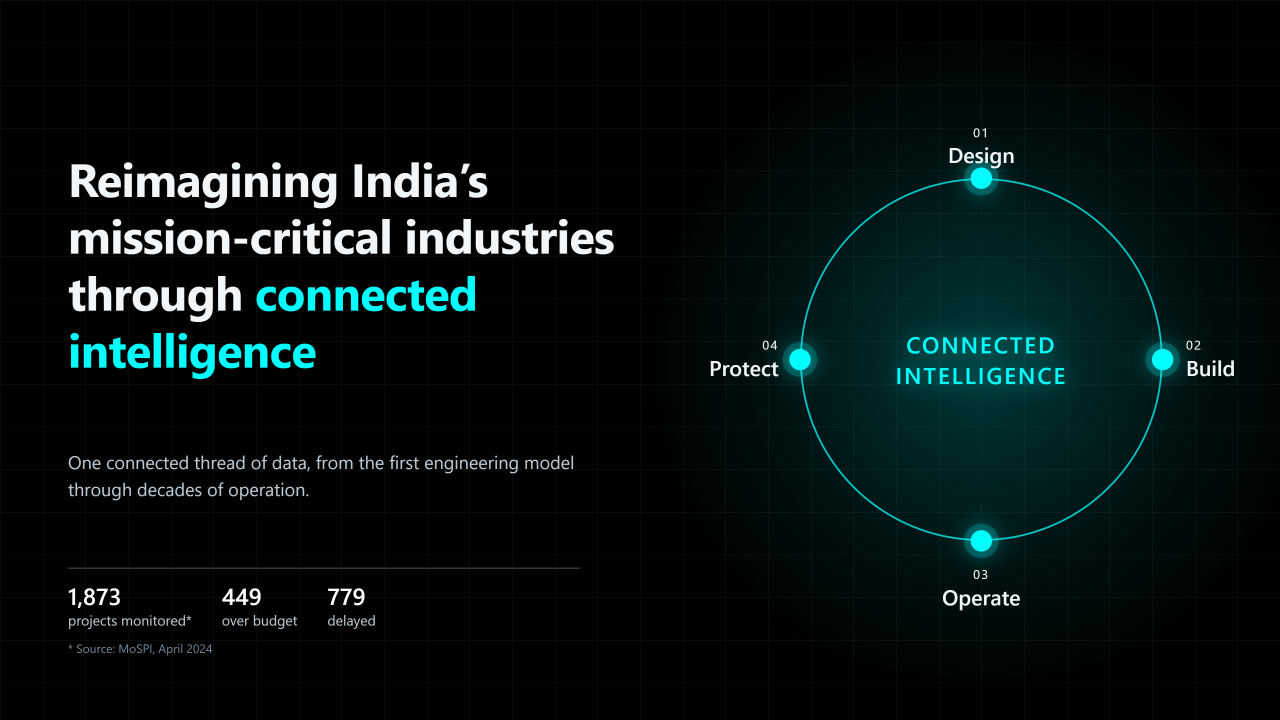
On project delivery, MoSPI data from April 2024 shows that of 1,873 monitored projects, 449 overshot their sanctioned costs and 779 suffered time delays. Cumulative overruns reached Rs 5.71 lakh crore, roughly US$70 billion, with average schedule slippage running to three years
Asset performance gets less attention, but its financial impact is just as real. Many industrial facilities still rely on paper-based or spreadsheet-driven maintenance records, with equipment history living in the memory of long-serving technicians rather than in accessible systems. The result is reactive management of assets, which then underperform their design specifications for decades.
The two problems are connected. A project that delivers a complete digital record at handover gives the operations team a foundation from which to manage the asset intelligently. A project that delivers a physical structure and a folder of PDFs forces the operations team to start from scratch.
More intelligence, rather than more data
So what would it take to have this digital thread of data that improves both project and asset performance?
When hearing that question, it is easy to think that the answer is “more data” or “more digital transformation,” but, in our experience, businesses and governments already have plenty of software and data sources. What they need is the intelligence layer: the capacity to connect the data they have, generate actionable insight, model scenarios and support decisions in near real-time.
Octave is built to bring this capacity across all four phases of the asset lifecycle: from design to build, operate and protect. It does so, not through four separate products, but with a single connected thread of data and context running from the first engineering model through decades of operation.
Each new data source, when connected, strengthens the whole. This is what we call connected intelligence: the end of fragmentation, silos, workarounds and disconnected islands of information.
The Numaligarh Refinery Limited (NRL) illustrates what this looks like in practice, and refining is a useful lens on why connected intelligence matters at this scale. India is already the world’s fourth-largest refiner, with installed capacity of around 258 million tonnes a year that the government wants to take towards 310 million tonnes by 2030 and as much as 400–450 million tonnes within two decades, much of it through brownfield expansions and integrated refinery-petrochemical complexes rather than new sites. NRL itself is mid-expansion: a roughly Rs 34,000 crore project is set to triple its own capacity from 3 to 9 million tonnes a year, alongside a new crude oil pipeline running more than 1,600 kilometres from Paradip on India’s east coast to Assam.
Five years ago, NRL set out to transform its project execution and operations using Octave’s digital twin platform, aiming for a single consolidated platform where multiple stakeholders’ data from multiple engineering authoring tools could be joined together. The platform now enables intelligent connectivity across work processes covering the complete facility lifecycle, with interoperability between engineering design tools and other operations systems and consistent, complete engineering master data throughout.
Geospatial intelligence: knowing the ground beneath the build
There is a dimension of connected intelligence that the construction and asset maintenance conversation often misses: the geospatial layer. Before a kilometre of road is laid, a pipeline trenched or a metro tunnel bored, someone has to know precisely what is there: the topology, utilities, the encumbrances and the environmental risks. In India, the gap between physical ground truth and digital representation has historically been one of the highest cost and schedule drivers.
Octave Alto, the high-performance geospatial platform used by defence, public safety and intelligence agencies in over 100 governments worldwide as well as the private sector, brings this capacity to both civilian infrastructure planning and operational environments. It enables teams to visualise, analyse and correlate spatial data in real time, combining sensor feeds, satellite imagery, LiDAR point clouds and engineering models into a single operational picture.
For large infrastructure and energy programmes – from highway corridors to refinery expansions and gas pipeline routes – this means survey data flowing directly into engineering design environments, eliminating the manual translation errors that have historically seeded mid-construction surprises.
The geospatial intelligence that is gathered during design and construction does not become redundant at handover : it becomes the spatial foundation for operations, maintenance routing and incident response throughout the life of the asset.
A unique window of opportunity
Today, with new infrastructure being built at this pace, there is a genuine window of opportunity. India holds an advantage most older economies do not: it is building large swathes of its critical infrastructure and energy capacity from scratch.
For example, Octave Attune was recently adopted by Pune’s Metro Line 3 to shift from reactive to condition-based maintenance at scale. New infrastructure of this kind can be designed with IoT sensor networks, digital handover specifications and information-rich engineering models from the outset, at a fraction of the cost of retrofitting them later.
The same logic applies to the geospatial layer: airports, highway and pipeline corridors and metro lines that are surveyed to modern precision from the start will carry that advantage through decades of operations and expansion. The intelligence gathered today becomes the training data and situational baseline for AI-assisted decision-making tomorrow. And in India’s cities, the ICCCs being built today are the nervous system into which a genuine public safety intelligence layer can be wired.
That’s for the opportunity – but connected intelligence is also about addressing India’s challenges head-on. For one, despite having the world’s largest working-age population, the country faces skills shortages in skilled maintenance professionals, electricians, welders, CNC operators and quality control professionals to meet industrial demand at scale. Connected intelligence platforms that automate routine monitoring, guide technicians through maintenance procedures and give operators a clear picture of unfolding situations reduce the reliance on tacit knowledge held by a small number of experienced individuals and extend the reach of the skilled professionals India does have.
Catching up, or leading the way?
In many domains, the world is watching what is happening in India: that’s true for the expansion of renewable energy, the new airports, the build-out of refining and petrochemical capacity or the scale of infrastructure investment.
What is being assessed is whether India is catching up or leading the way. Key to that question is whether the country can build the connected intelligence layer that turns physical infrastructure, cities or defense assets into efficient, self-optimising systems.
India’s success in this investment cycle will depend on how efficiently the country connects each stage of its assets’ lifecycle: design, build, operate and protect. Project cost overruns, delays, handover failures, data silos, fragmented public safety systems and disconnected architectures are not inevitable: with Octave’s connected intelligence, they can be addressed through the consistent, continuous flow of the right data, so that the energy infrastructure, transport corridors and cities being built today deliver lasting value rather than underperforming their potential for a generation.