Data-Driven Performance in Pharmaceutical Manufacturing
From OEE to Energy Monitoring and Continuous Improvement with CORVINA Smart Manufacturing
In pharmaceutical manufacturing, performance is no longer measured only by production output. Manufacturers today must balance productivity, compliance, energy efficiency and operational consistency, often within highly regulated and complex environments.
Exor India Pvt. Ltd., as the Indian subsidiary of the Italian Exor International S.p.A. and a Corvina S.r.l. partner, supports OEMs and manufacturers in this evolution through Corvina Smart Manufacturing technologies, designed to transform production data into structured operational intelligence.
In this context, concepts such as OEE monitoring, energy management and production improvement are no longer isolated initiatives. They are becoming interconnected elements of a broader data-driven manufacturing strategy.
Turning production data into operational intelligence
Most pharmaceutical plants already generate large amounts of production data. Machines, PLCs, sensors and enterprise systems continuously exchange information across the production environment.
However, visibility alone is not enough. One of the most common challenges in manufacturing environments is the fragmentation of data across machines, departments and software layers. This often leads to delayed decisions, reactive problem-solving and limited traceability of operational losses.
Corvina Smart Manufacturing addresses this challenge by creating a structured data foundation that connects machines, workflows and operational processes into a unified environment.
The objective is not simply to collect data, but to make it contextualized, actionable and scalable across the plant.
OEE as a real-time operational indicator
Overall Equipment Effectiveness (OEE) has become one of the most important indicators for evaluating manufacturing performance.
Yet in many facilities, OEE is still calculated manually or analyzed only after production shifts have ended. This limits its value as an operational decision-making tool.
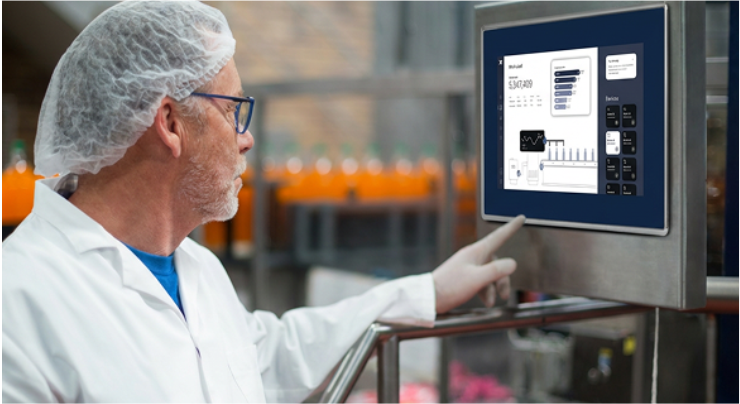
Corvina’s Smart Manufacturing approach enables real-time KPI monitoring directly from the shop floor, combining machine data, downtime analysis and production information into structured dashboards accessible across the organization.
By making losses, stop causes and production inefficiencies visible in real time, manufacturers can move from reactive analysis toward same-shift corrective actions and more consistent operational control.
This transforms OEE from a reporting metric into a daily operational management tool.
Energy monitoring as part of manufacturing performance
Energy efficiency is also becoming increasingly important in pharmaceutical production, where utilities and process stability have a direct impact on operational costs and sustainability targets.
The challenge is that energy consumption is often monitored separately from production performance, making it difficult to understand the real relationship between energy usage and manufacturing efficiency.
Through structured data collection and contextualized dashboards, Corvina Smart Manufacturing enables manufacturers to correlate production activity, machine utilization and energy consumption within the same operational framework.
This allows plants to identify:
- energy-intensive production phases
- inefficient machine behavior
- abnormal consumption patterns
- opportunities for process optimization
In this way, energy monitoring becomes part of production intelligence rather than an isolated reporting activity.
Continuous improvement through structured workflows
Data-driven manufacturing also requires structured operational processes.
Corvina Smart Manufacturing integrates Lean-oriented digital workflows that support issue escalation, cross-functional collaboration and continuous improvement activities.
Modules dedicated to performance meetings, PDCA workflows and service management allow manufacturers to connect operational events with improvement actions in a traceable and measurable way.
This helps transform production data into guided operational decisions, reducing reaction time while improving coordination between production, maintenance and quality teams.
Instead of isolated corrective actions, manufacturers can establish repeatable improvement cycles supported by real-time information.
Structured operations for regulated industries
In regulated sectors such as pharmaceuticals, operational performance cannot be separated from traceability and compliance.
Production data must remain reliable, contextualized and auditable throughout the lifecycle of the process.
Corvina Smart Manufacturing supports this through structured data models, role-based access control, auditability and ISA-95-oriented architectures designed to align shop-floor operations with MES and enterprise systems.
This allows manufacturers to improve operational efficiency while maintaining the consistency and governance required in regulated production environments.
Data-Driven Performance for Pharma Manufacturing
As pharmaceutical manufacturing becomes increasingly digitalized, the competitive advantage is no longer defined only by machine connectivity.
It is defined by the ability to structure production data into meaningful operational intelligence.
OEE monitoring, energy management and continuous improvement are no longer separate initiatives. Together, they form the foundation of a more connected, responsive and performance-oriented manufacturing model.
This is the principle behind Corvina Smart Manufacturing: enabling manufacturers to transform production data into structured operations, measurable performance and continuous improvement.
For more details: www.exorint.com